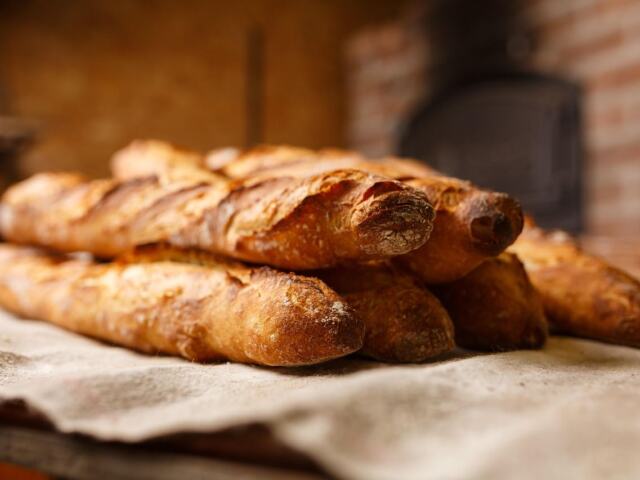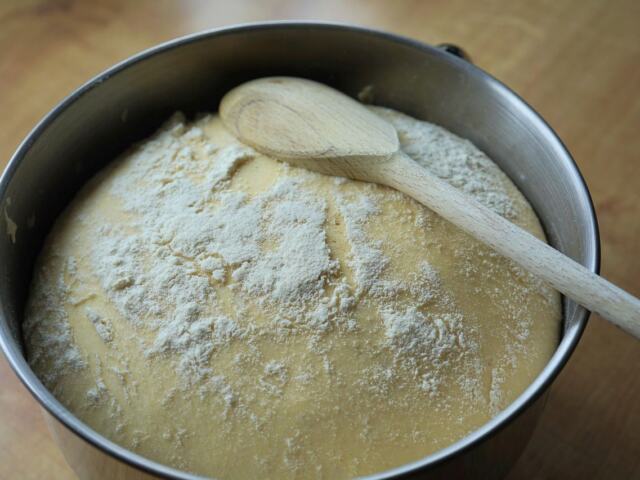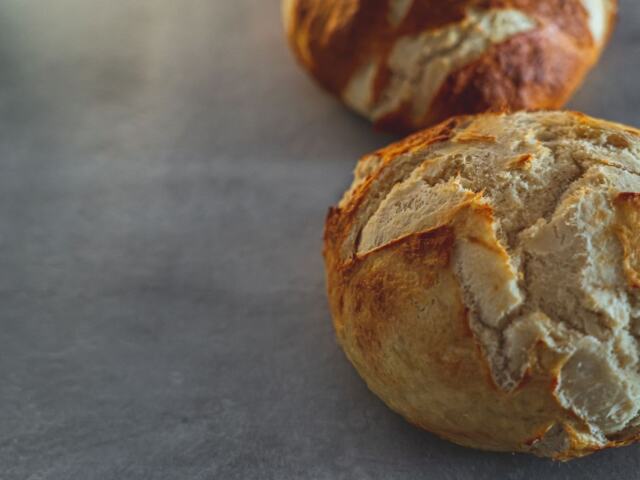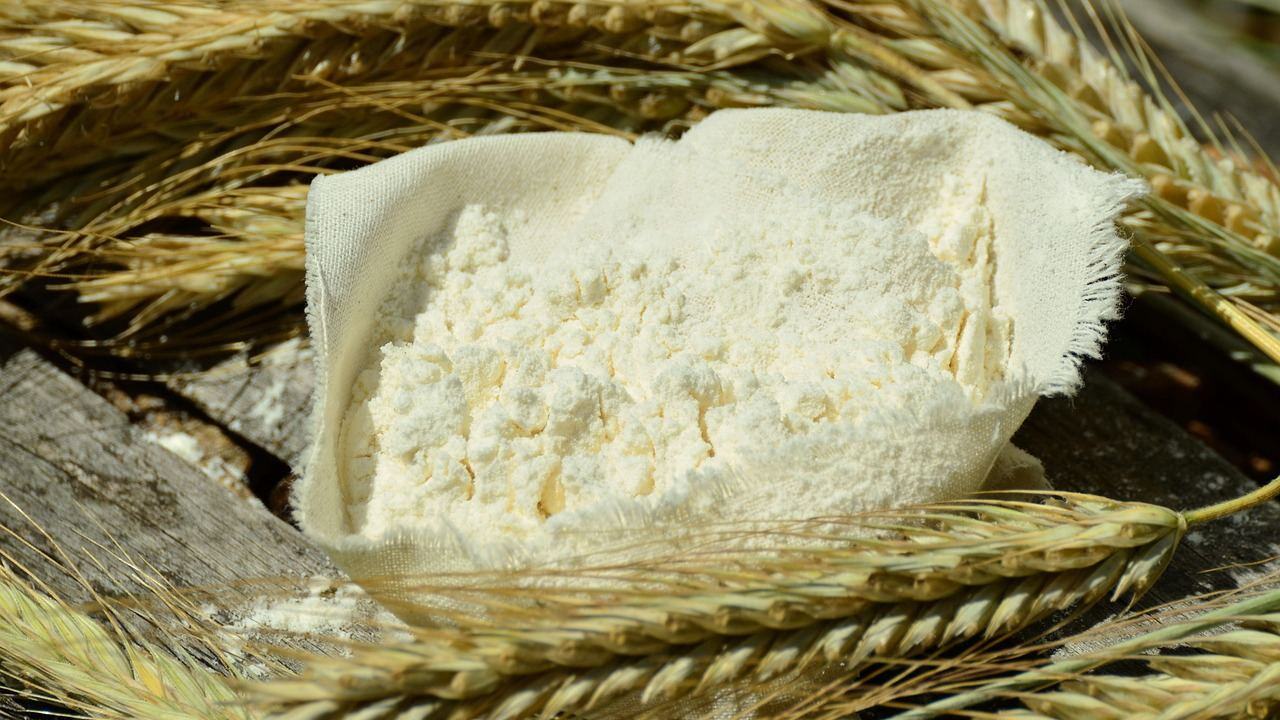
Your French recipe calls for T55 and your shelf has none. French flour type 55 is a versatile white flour, and a blend of all-purpose and bread flour is your closest swap.
If you are working through more bread and pastry basics, the French baking section gathers related guides in one place.
| Item | Value |
|---|---|
| Ash content of T55 | 0.5% to 0.6% |
| Extraction rate of T55 | 75% |
| Typical protein in a “Tradition” T55 or T65 flour | approximately 10% |
| Highest protein suggested for French bread flour | 12 to 12.5% |
| French flour grading law in effect since | 1 October 1963 |
These figures come from CooksInfo’s page on French flours and Bruno Albouze’s flour guide. They can change, so check the source before you rely on them.
What French flour type 55 actually means
In France, a bag of flour carries a “T” for type, followed by a number. That number reflects the ash content: the mineral residue left after a small flour sample is incinerated at 900°C, as explained on a Relais Desserts page dated 21 April 2024.
Those minerals sit mostly in the bran, the outer shell of the wheat kernel. A low number therefore means a highly refined, very white flour with little bran, and a high number means a darker flour with more bran and a more rustic flavour.
T55 sits in the middle of the white flours, with an ash content of 0.5% to 0.6%. CooksInfo also lists an extraction rate of 75% for Type 55, which is the weight of flour obtained relative to the wheat you started with.
The grading system has a long history. As of CooksInfo’s page updated on Jan 25, 2021, a French law grading flour by ash content has been in effect since 1 October 1963.
How T55 compares with other French flour types
The easiest way to place T55 is to see it beside its neighbours. The table below uses the ash ranges and typical uses from Bruno Albouze’s guide.
| Flour type | Ash content | Typical uses |
|---|---|---|
| T45 | 0.4% to 0.5% | Croissants, brioche, puff pastry, financiers, cakes, crêpes |
| T55 | 0.5% to 0.6% | Baguettes, white bread, pizza dough, pies, choux pastry |
| T65 | 0.62% to 0.75% | “Tradition” baguettes, sourdough, rustic long-fermented breads |
| T80 | 0.75% to 0.9% | Heartier country breads, often mixed with T65 |
| T110 | 1.0% to 1.2% | Wholemeal bread such as pain complet |
The ash ranges and typical uses in this table come from Bruno Albouze’s flour guide, and they can change, so check that page before you rely on them.
Read the table from top to bottom as a ladder of refinement: each step up keeps more bran, so the ash figure rises. The ranges for T55 (0.5% to 0.6%) and T65 (0.62% to 0.75%) sit close together, which helps explain why the sources give them overlapping bread jobs.
The CooksInfo page on French flours says each type is a category rather than a single product: there are many flours called Type 55, and the type is just an indication of how white the flour is. Its examples include a Type 55 sold for crêpes, another for crusty breads, and others for country breads, sourdough or baguettes. To find out what a given bag is good for, the page says you have to read the packet.
What T55 is good for
Bruno Albouze calls T55 the classic French flour for everyday baking, with a good balance of structure and a neutral flavour. Relais Desserts describes it as a multipurpose flour for pastry work.
Between the two sources, these are the uses named for T55:
- Standard baguettes and white bread
- Pizza dough
- Pies
- Choux pastry
- Shortcrust pastry and fruit tarts
The sources do not draw the line in exactly the same place. Relais Desserts lists white bread under T65, while Bruno Albouze lists standard white bread under T55 and “Tradition” baguettes under T65.
Enriched doughs are where the choice matters most. Bruno Albouze lists brioche under T45, and Relais Desserts warns that the same flour cannot serve for both brioche and wholemeal bread, so check the flour named in your brioche recipe before you swap in T55.
What to substitute for T55
CooksInfo’s advice is to mix some all-purpose (plain) flour into bread (strong) flour. Bread flour on its own is, in its words, probably too strong for any French recipe, and the highest protein content you would want for French bread is 12 to 12.5%.
Here is a practical way to apply that advice:
- Read the protein figure on your bread flour label. If it is above 12 to 12.5%, it is stronger than a French bread recipe wants.
- Replace part of the bread flour with all-purpose flour to bring the blend down, and adjust the proportion over a few bakes as you see how the dough feels.
- Test the blend on something simple first. A plain white dough such as the fougasse recipe makes a low-risk trial.
- Compare the crumb and crust with what the recipe promises, then fine-tune the blend next time.
For pastry, the choice is simpler. Since one guide describes T55 as a versatile all-purpose flour, plain all-purpose flour is a reasonable starting point for shortcrust, choux and tarts.
Expect some differences in the dough itself. In My Life in France, Julia Child wrote that French flour has more body than its U.S. counterpart, and that the French needed a third less fat to make a nice crumbly crust, as quoted by CooksInfo.
Reading the bag: tradition, corrected and plain flour
A French packet can carry labels that change how the flour behaves, even when it says T55. Three are worth knowing:
- Farine de tradition: found on T55 or T65 bags, and described by Bruno Albouze as guaranteed to be without additives such as ascorbic acid or malted barley flour.
- Farine complémentée: “corrected flour” with corrective elements added, such as fava bean or soy bean flour.
- Panifiable: on a French packet, this means suitable for making bread.
The two flour styles differ in purpose. Per CooksInfo’s January 2021 update, the additives in corrected flour oxidize the flour, which whitens it and strengthens the gluten of the weaker wheat grown by the French. Uncorrected flour is called farine de base.
A traditional T55 or T65 is said to have a typical protein content of approximately 10%. That is a useful reference point when you compare it with a strong bread flour from your own supermarket.
Frequently asked questions
Is T55 the same as all-purpose flour?
Show answer
Not exactly. Bruno Albouze describes T55 as a versatile all-purpose flour, but French flours are graded by ash content rather than by protein, so all-purpose flour is a substitute rather than a twin.
Can I use bread flour on its own instead of T55?
Show answer
CooksInfo says bread (strong) flour on its own is probably too strong for any French recipe. It suggests mixing in some all-purpose (plain) flour, and keeping protein to 12 to 12.5% at most for French bread.
What does panifiable mean on a flour bag?
Show answer
According to CooksInfo, panifiable on a packet of flour in France means suitable for making bread.
Is T55 or T65 better for baguettes?
Show answer
The sources differ. Bruno Albouze lists T55 for standard baguettes and T65 for “Tradition” baguettes, so the answer depends on the style of baguette you want to bake.