Stuck on poolish vs levain for your next loaf? Pick poolish for mild, wheaty flavour built with a pinch of commercial yeast; pick levain for sourdough tang built from your own starter.
This guide sits in the French baking section, where pre-ferments come up again and again.
| Item | Value |
|---|---|
| Poolish hydration | 100% (equal weights of flour and water) |
| Poolish fermentation time | 8 to 14 hours at room temperature |
| Poolish share of total flour | 20% to 40% |
| Levain build time | 4 to 6 hours at 75°F to 78°F (24°C to 26°C) |
| Levain share of total flour | 15% to 25% in most home sourdough formulas |
These figures come from the Dough Formula guide to poolish, biga and levain, dated February 27, 2026. Figures can change and every kitchen runs differently, so check the source before you rely on them.
What a pre-ferment actually does for your bread
A pre-ferment is a portion of your dough made hours ahead of the final mix. King Arthur Baking describes it as a mixture of flour, water, leavening (commercial yeast or sourdough starter), and time. Poolish and levain differ mainly in that choice of leavening.
According to the Dough Formula guide, acids and aromatic compounds from the long pre-ferment carry through into the finished crumb, even though the pre-ferment is usually only 20 to 40 percent of the total flour.
A Real Bread Campaign article lists three practical reasons to use one:
- Flavour and aroma: the longer fermentation runs, the more flavour and aroma compounds build up, so a pre-ferment helps a shorter process.
- Yeast vigour: in a straight dough the yeast has to go “from nought to full throttle straight away”, while a pre-ferment gives it a run-up.
- Gluten: rising acid strengthens gluten, whereas a looser starter fermented at room temperature without salt has more protease activity and a stretchier dough.
That last point is where the two options start to pull apart. One is wet, mild and yeast-driven; the other is acidic and sour.
Poolish: the wet, yeast-driven pre-ferment
Poolish is equal weights of flour and water (100% hydration) with a small amount of commercial yeast. According to the Dough Formula guide, it originated in Poland and was adopted in France in the 19th century. It is used in French baguettes, many pizza doughs and any bread where you want open crumb and complex wheat flavour without sourdough tang.
The Dough Formula guide gives a typical poolish formula of 200g bread flour, 200g water, 0.2g to 0.5g instant yeast. The yeast is tiny on purpose, because a long, slow ferment is the point.
Timing and readiness
Expect a poolish to take 8 to 14 hours at room temperature (around 68°F to 72°F / 20°C to 22°C). A cooler kitchen stretches that: at 65°F (18°C) it may not peak until 14 to 16 hours. Read your own kitchen rather than the clock.
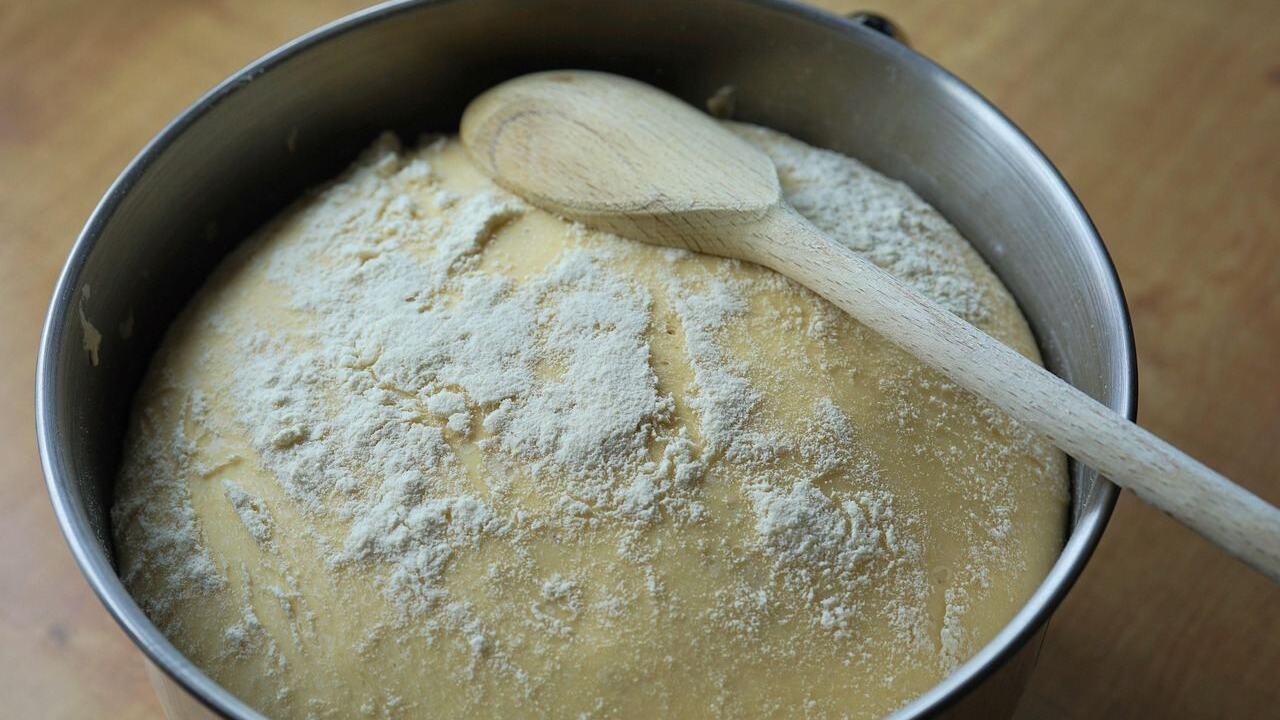
A ripe poolish looks like batter, with a domed or slightly fallen surface covered in small bubbles. The same guide advises using it at or just before the dome falls for the best balance of flavour and activity. Poolish is also forgiving, because Chainbaker points out you add more yeast to the final dough, so the poolish’s own leavening is not as crucial.
Adjust your final water
Poolish is wet, so it changes your final dough. A 200g poolish at 100% hydration brings 100g of water into the final dough, and the Dough Formula guide says your final dough water must be reduced accordingly.
The same high hydration has a handling cost. Chainbaker notes it brings more enzyme activity, giving more extensibility and a potentially better rise in the oven, but also a dough that is more difficult to handle.
Levain: the sourdough build
A levain (from the French word for leaven) is a sourdough pre-ferment. It is a timed build that uses your sourdough starter as the seed culture rather than commercial yeast, as the Dough Formula guide explains. It carries wild yeast and lactic acid bacteria, which is where the full sourdough flavour comes from.
The Real Bread Campaign describes the underlying culture simply: water is added to flour to culture the yeasts it contains until they can raise dough, while potentially beneficial bacteria also thrive.
A simple build
One typical build takes 20g of active starter, adds 80g flour and 80g water, and leaves the mix at 75°F to 78°F (24°C to 26°C) for 4 to 6 hours. You are looking for a levain that has at least doubled and shows a dome on top. The amount of starter you start with sets the pace:
- A smaller seed, 10% of the levain flour weight, ferments slowly over 8 hours.
- A larger seed, 20% or more, peaks in 3 to 4 hours.
Match the seed amount to your schedule, then use the levain in the final dough at 15% to 25% of total flour for most home sourdough formulas.
Timing matters more
With a levain, the moment you mix matters. The Dough Formula guide warns that a levain past its peak loses yeast activity and leavening power rapidly, so use it at the dome. A float test, where the levain floats in water, is a useful rough check but not a guarantee.
That is the opposite of poolish. A late poolish still leavens enough because fresh yeast goes into the final dough, whereas a late levain is doing the leavening itself.
Poolish vs levain side by side
| Feature | Poolish | Levain |
|---|---|---|
| Leavening | Commercial yeast | Wild yeast and lactic acid bacteria |
| Hydration | 100% | 80-100% |
| Typical build time | 8 to 14 hours | 4 to 6 hours |
| Share of total flour | 20% to 40% | 15% to 25% |
| Flavour | Mild, wheaty, no sourdough tang | Full sourdough flavour |
| If used late | Forgiving | Loses leavening power quickly |
The figures in this table come from the Dough Formula guide, and the comparison of late use draws on Chainbaker; check both sources before you rely on them.
Do not read the build times as a race. The Dough Formula guide gives its poolish time at around 68°F to 72°F and its levain time at a warmer 75°F to 78°F, so the two are not measured in the same kitchen conditions.
Flavour and shelf life also differ. Chainbaker notes that the more acidic a bread is, the longer it will stay fresh. That favours the sour side of the comparison, though the guide makes the point about acidic pre-ferments in general rather than levain alone.
How do you choose between them?
Start with the bread you want and the starter you have. These rules of thumb follow from the sources above:
- Choose poolish if you want open crumb and wheat flavour without sourdough tang, or if you do not keep a starter. The guide on how to make baguette at home is a natural next read, since baguettes are the classic poolish bread.
- Choose levain if you want real sourdough character and enjoy keeping a starter alive. Its acidity also strengthens gluten, which the Real Bread Campaign says is useful with weaker flours.
- Choose by schedule: a levain can be ready in a working morning if you size the seed well, while a poolish suits an overnight mix.
If you want a rustic French loaf to test either approach on, try the pain de campagne recipe and adjust the flavour direction to your taste. Change one variable at a time, and note the hours and room temperature each time. That record is worth more than any chart.
Frequently asked questions
Can I swap a poolish for a levain in the same recipe?
Show answer
Often, with changes. Chainbaker says most pre-ferments can be used interchangeably with some modification. Expect a different flavour, and rebalance the water in the final dough.
What if my poolish goes past its peak?
Show answer
It is still usable. The Dough Formula guide recommends using it at or just before the dome falls for the best balance of flavour and activity, but Chainbaker points out that poolish is forgiving because more yeast goes into the final dough.
Is biga the same as poolish?
Show answer
No. The Real Bread Campaign describes biga as a stiffer dough pre-ferment of perhaps 50-60% hydration, while a poolish is a batter at around 100%.
How do I know my levain is ready?
Show answer
Look for a levain that has at least doubled and shows a dome on top. The float test is a useful rough check, not a guarantee, so judge by the dome and by how long it has been fermenting.