Wondering how long to leave your dough? Bulk fermentation time is usually 3 to 8 hours, but dough temperature and rise matter more than the clock. Watch the dough, not the timer.
Bulk fermentation is one stage of artisan bread baking, so read this page alongside the rest of that topic.
| Item | Value |
|---|---|
| Typical bulk fermentation time | 3 to 8 hours |
| Ideal dough temperature | 25-28°C |
| Target dough rise | 30-50% |
| Temperature step that doubles or halves the time (rule of thumb) | 15F/8C |
| Dough temperature to stay under | 90F/32C |
The figures come from You Knead Sourdough’s bulk fermentation FAQ and The Sourdough Journey’s timing FAQ. They can change, so check the source before you rely on them.
What happens during bulk fermentation
Bulk fermentation is the first rise of your dough. The yeast inflates the dough with carbon dioxide while the lactic acid bacteria build flavour, as The Sourdough Journey’s timing FAQ describes it.
Several things are going on at once:
- Yeast produces gas, which gives the dough its rise and structure.
- Bacteria develop acids, which deepen flavour.
- Gluten strengthens through gentle stretch and folds.
The catch is the protease enzyme. The longer the dough ferments, and especially at warm temperatures, the more this enzyme eats gluten and starts to deteriorate the loaf, which is what causes overproofing. Your job is to get enough fermentation and rise before the dough becomes too acidic and begins to break down.
Why temperature sets your bulk fermentation time
Most doughs finish in 3 to 8 hours, according to You Knead Sourdough, which names 25-28°C as the ideal temperature range. Colder kitchens slow things down, while warmer ones speed things up.
The Sourdough Journey separates warm bulk fermentation, at a dough temperature of 78-82F/26-28C, from cooler bulk fermentation at 54-74F/12-23C. For dough between 74-78F/23-26C, either approach works with slight modifications, according to its timing FAQ.
The same FAQ gives a rule of thumb: a 15F/8C change in dough temperature doubles or halves the fermentation time, and warmer dough always ferments faster. Its author calls the rule generally accurate in their experience, so treat it as a rough guide rather than a promise.
The same author describes approximate timing as a weak predictor of when to end bulk fermentation, as the percentage rise article explains. Use the hours to plan your day and the dough itself to decide.
How much should the dough rise?
Plenty of recipes say to wait until the dough doubles. The Sourdough Journey answers that question with a flat no, and says the right rise depends on dough temperature.
You Knead Sourdough suggests a 30-50% rise, with 30% in warmer climates and closer to 50% in cooler ones, in its bulk fermentation FAQ. A wider spread appears in another Sourdough Journey article: Tartine-style recipes at 80F/27C recommend about 30%, while recipes at 70F/21C recommend 75-100%.
These numbers look like they clash, but they describe different dough temperatures. A rise percentage means little unless you also know how warm the dough was.
For its own bakes, The Sourdough Journey usually aims for a 35% rise with warm dough and a 55-60% rise with cool dough, per the timing FAQ. Starters and flours differ, so treat any target as a starting point.
If the loaf overproofs, reduce the target rise by 10% on your next bake. If it underproofs, raise the target by 10%, as the percentage rise article advises. Keep notes on dough temperature and rise, and you can settle on a number for your recipe within a few bakes.
Signs your bulk fermentation is done
Time and rise give you a window, and the dough tells you when to act inside it. Work through these checks as the end approaches:
- Take the dough temperature and note it.
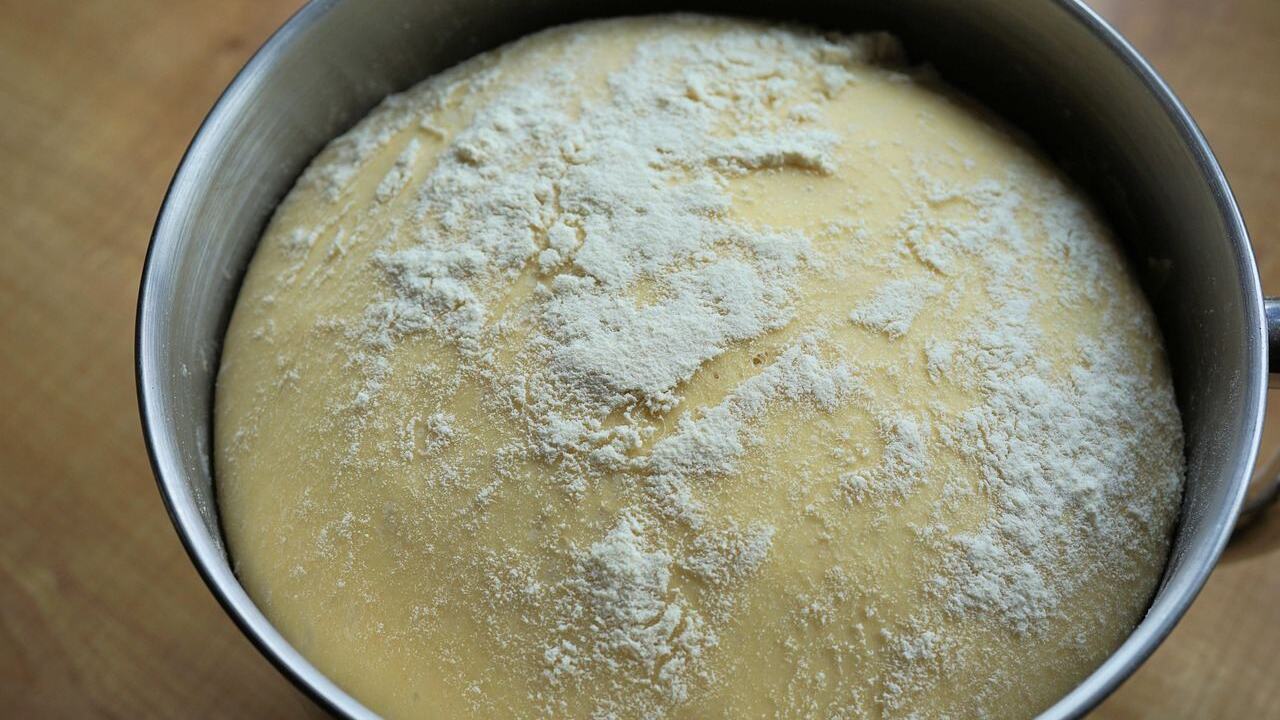
- Compare the dough’s volume with where it started to find the percentage rise.
- Match that rise to the target for your dough temperature.
- Feel the dough: it should be smooth and pillowy, no longer sticky on the surface, and able to hold its shape when gently touched.
- Check the smell, the stiffness or looseness of the dough and the sheen on its surface.
The feel-based signs come from You Knead Sourdough, which also warns that surface bubbles are not the best indicator. The smell, stiffness and sheen cues are the variables The Sourdough Journey says experienced bakers read.
To learn about another early step in the process, read what is autolyse.
What happens after bulk fermentation ends
The dough does not hear your decision to stop. It keeps fermenting through shaping, and warm dough at 80F/27C can grow by at least 10% during the 40 minutes of pre-shaping, bench rest and final shaping, according to The Sourdough Journey. You do not see that rise because you are handling the dough.
A cold retard does not stop it right away either. The same article says shaped dough can take 8-12 hours to cool to a fridge temperature of 37F/3C, and it ferments most in the first few hours while it is still above 50F/10C.
The oven adds a last burst: fermentation carries on until the dough reaches the yeast die-off point of 130F/54C. This is why warm dough needs an earlier cutoff, so that some fermentation capacity is left for the oven.
Once the dough is shaped and proofed, the next skill is how to score bread before it goes in the oven.
Adjusting for your kitchen and starter
A weak starter drags out the timeline whatever the temperature. You Knead Sourdough says a starter that is not bubbly and doubling within 4-6 hours of feeding could slow down or even stall fermentation, and that a higher starter percentage speeds things up while less slows them down, in its FAQ.
If your kitchen is cold
The same FAQ lists a few ways to add warmth:
- Use a proofing box.
- Place the dough in the oven with the light on.
- Wrap the bowl in a warm tea towel.
If your kitchen is warm
In a kitchen at 28°C or above, You Knead Sourdough suggests cooler water in the dough and close watching, because fermentation can move fast. It also suggests stopping at only a 30% rise, then cold-proofing.
Oven proof settings and the fridge
Do not trust an oven’s proof setting blindly. The author at The Sourdough Journey measured two ovens that reached about 105F/45C, and warns that dough above 90F/32C will rapidly begin to overproof.
The same FAQ says the fridge is too cool for bulk fermentation. Moving dough there for the last hour or so is possible, but it is not generally recommended because the effects are hard to predict.
Frequently asked questions
Does my dough need to double during bulk fermentation?
Show answer
Not necessarily. The Sourdough Journey says the right rise depends on dough temperature, with cooler dough tolerating a bigger rise and warmer dough usually calling for a smaller one.
Can I bulk ferment in the refrigerator?
Show answer
The same source says no, because the refrigerator is too cool for bulk fermentation. You can move dough there near the end, and it keeps fermenting until it cools down, per its timing FAQ.
How long does bulk fermentation take in a warm kitchen?
Show answer
You Knead Sourdough puts the general range at 3 to 8 hours, with 25-28°C as the ideal temperature. Warmer dough runs toward the short end, so check the dough often, as its FAQ advises.
What causes overproofing?
Show answer
The protease enzyme eats gluten and starts to deteriorate the loaf as fermentation runs long, especially in warm dough, according to The Sourdough Journey. If your loaf overproofs, the percentage rise article advises lowering your target rise by 10% on the next bake.